Design for Manufacturing (DFM) for PCBs: Electronic Boards That Are Easier to Build
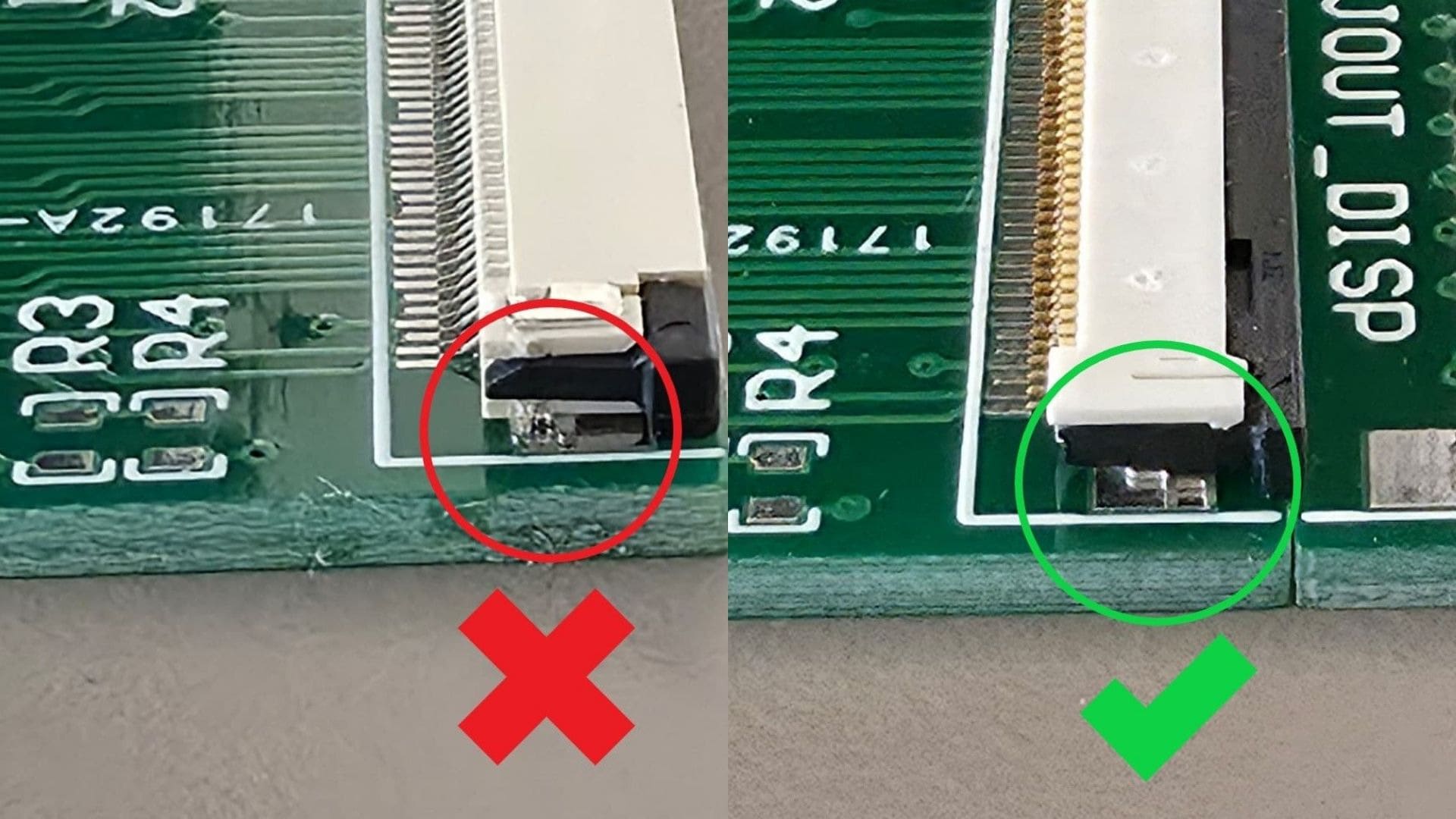
A smaller component is not always the better choice. DFM connects PCB layout, SMT assembly, component availability and series production.
AOI, X-ray inspection, ICT and functional testing are different but complementary checks. Here is how they improve reliability, traceability and quality in PCBA manufacturing.
The quality of an electronic board is not measured only at the end of the line.
By the time a product reaches final testing, much of its reliability has already been decided: in the design choices, the layout, the bill of materials, the assembly process, the soldering and the inspection strategy built around the board.
This matters, especially for people working in R&D or purchasing.
For a design team, a well-inspected board means fewer problems during validation, less rework and less after-the-fact analysis of defects that are hard to isolate.
For those who buy electronics, it means a lower risk of downtime, returns, disputes, late deliveries and the hidden costs of poor quality.
At Electra, inspections are not treated as an end-of-process formality. They are part of the industrialisation and production path. They are chosen based on the board, the complexity of the design, the components used and the level of reliability the application requires.
The principle is simple: you don’t need to check everything in the same way. You need to check what matters, at the right time, with the right tool.
When it comes to electronics quality, there is a tendency to oversimplify: “the board has been tested” or “the board passed testing“.
In reality, a board can be checked from very different angles.
One inspection can check whether components are present and correctly oriented.
Another can examine solder joints that are not visible from the outside.
Another can measure continuity, insulation and electrical values.
Finally, functional testing can check whether the board behaves as intended when it is powered and run according to the design logic.
These are different levels. And they are not interchangeable.
AOI cannot tell you whether the firmware runs a sequence correctly.
A functional test can catch a malfunction, but it does not always reveal straight away whether the cause is a solder joint, a wrong component or a design problem.
X-ray can see hidden joints, but on its own it cannot confirm that a circuit works.
ICT can detect many electrical and assembly defects, but it requires a board designed to be testable.
Quality comes precisely from a well-reasoned combination of these inspections.
AOI (Automated Optical Inspection) is an automated optical check used to inspect the board after assembly, particularly in SMT processes.
Its job is to detect visible defects: missing, misaligned or rotated components, components fitted with the wrong polarity, non-compliant solder joints, solder bridges, lifted leads, and excess or insufficient solder.
It is a fast, repeatable and very useful inspection because it reduces reliance on manual inspection alone. On dense boards with many components and ever smaller packages, the human eye cannot be the only verification tool.
The value of AOI, however, is not just in “finding the defect”.
An optical inspection system also helps you read the process. If the same type of misalignment, the same solder bridge or the same anomaly on a family of components keeps appearing in a production run, the inspection becomes a signal. It may indicate that a process parameter, a placement step, a soldering condition, a solder paste stencil or an aspect of the layout needs reviewing.
That is why AOI should not be seen as a simple exit gate. It is a tool for controlling and improving the process.
It does have an obvious limit, though: it checks what is visible. When the joints are underneath the component, as with BGA, QFN, LGA or other packages with hidden terminations, a different kind of inspection is needed.
Miniaturisation has made many electronic boards more compact, more powerful and harder to inspect.
Components such as BGAs and QFNs are very useful from a design and functional point of view, but they introduce a practical problem: a critical part of the connections cannot be seen from the outside.
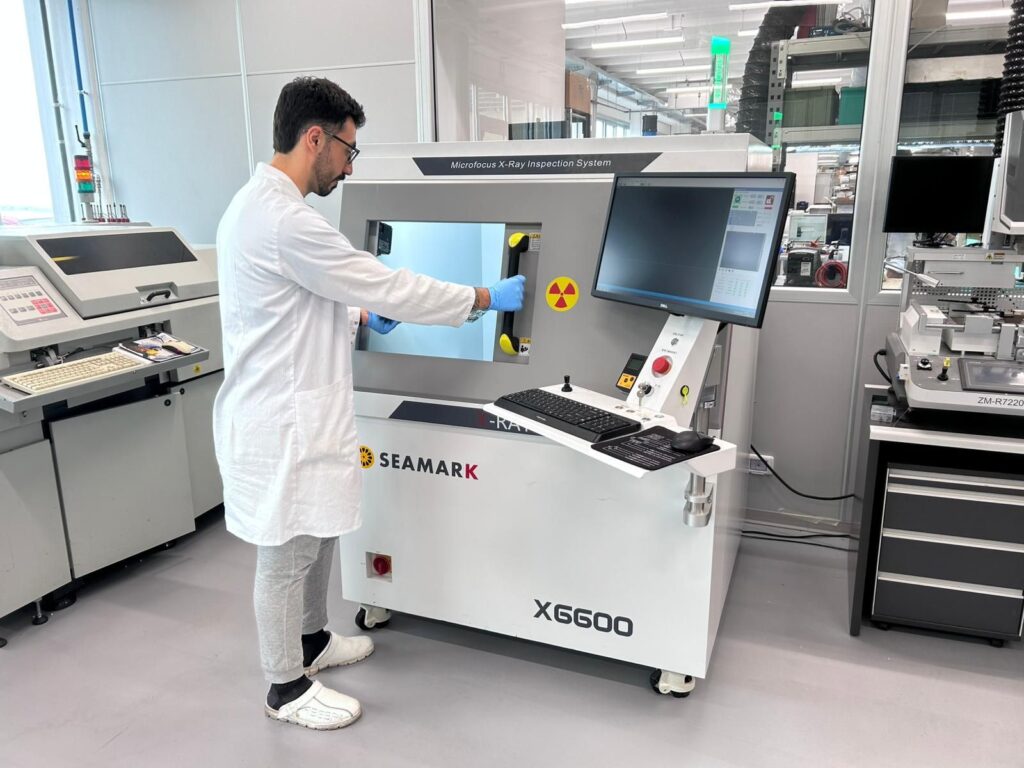
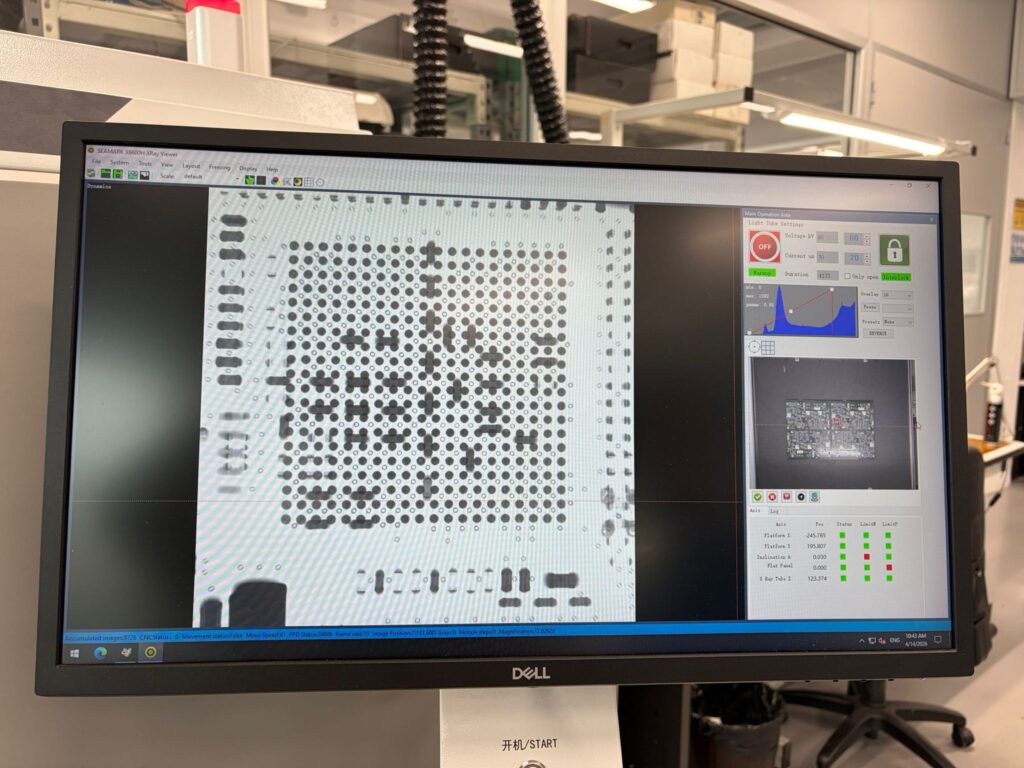
In these cases, X-ray inspection makes it possible to analyse what AOI cannot see.
X-ray inspection can be used to check the quality of hidden joints and detect anomalies such as excessive voiding in solder joints, bridges between balls, incomplete solder joints, misalignment, opens, wetting problems or localised defects under the package.
It is particularly important in three situations:
For an R&D team, X-ray is often invaluable because it links a functional problem to a possible physical cause. A board may fail a test not because the design is wrong, but because a joint under a critical component is faulty.
For the purchasing department, on the other hand, having this kind of inspection available is an indicator of the supplier’s ability to handle complex boards and non-trivial components.
Here too, it is important not to overpromise: X-ray does not replace electrical and functional tests. It can show the physical quality of a hidden connection, but it cannot tell you whether a component has the correct value, whether the firmware works as intended or whether the board responds correctly in all operating conditions.
ICT (In-Circuit Test) is an electrical test designed to check the board at circuit and component level.
Unlike AOI, it is not limited to appearance. ICT uses contact points, probes or dedicated fixtures to take electrical measurements on the assembled board. It can check continuity, insulation, short circuits, open circuits, component presence, electrical values and certain assembly conditions.
Its advantage is very concrete: it helps catch defects before functional testing, reducing diagnosis and rework time.
If a board has a short, a missing component or a wrong value, it is better to find out before powering it up and putting it through functional testing. That way no time is wasted on boards that already have a basic structural or electrical problem.
ICT is particularly useful in repeat production, where test speed, precise diagnosis and process stability have a direct impact on costs and overall quality.
But effective ICT cannot be improvised.
To test a board properly, you have to plan for it in advance. You need accessible test points, correct spacing, measurable nodes, mechanical constraints compatible with the test system and a strategy defined during the design and industrialisation stages.
This is what Design for Testability is about: designing a board not only so that it works, but so that it can be checked effectively and repeatably.
A board that was not designed to be tested can make inspection slower, more expensive or less thorough. Conversely, a board designed with testing in mind helps production, quality and R&D work better.
Functional testing checks whether the board behaves as intended.
This is not just about checking whether a component is properly soldered or a track is continuous. The board is powered, stimulated and its responses are observed.
Depending on the design, the test can include checks on power supplies, inputs and outputs, analogue and digital signals, communication protocols, firmware, sensors, actuators, interfaces, current draw, operating sequences and operating thresholds.
It is the inspection closest to how the board will actually be used.
That is why it is essential, especially when the board is not a simple sub-assembly but the electronic heart of a device, a machine or a larger system.
Functional testing answers a different question from the other tests: does the board really do what it was designed to do?
It is an essential question, but not always enough on its own. A functional test can tell you that the board does not respond as expected, but it does not always identify the cause immediately. That is why it is most effective when it follows well-structured visual, physical and electrical inspections.
The right sequence of inspections helps reduce uncertainty: first you catch assembly and connection defects, then you check overall behaviour.
When choosing an electronics manufacturing partner, the unit price of the board is only part of the assessment.
For a purchasing department, the real cost also includes scrap, rework, downtime, delays, non-conformity management, warranty claims and the risk of problems in the field.
For an R&D department, a well-designed inspection process reduces ambiguity. When a problem arises, it is easier to tell whether the cause lies in the design, the component, the process or the assembly.
This is one of the reasons why the test strategy should be discussed early, not when the board is already in production.
Some questions are worth asking as early as the industrialisation stage:
Answering these questions helps avoid two opposite mistakes: testing too little, letting significant risks slip through, or testing generically, adding cost without really increasing reliability.
A reliable electronic board does not come from putting it through as many tests as possible.
It comes from choosing inspections methodically.
AOI, X-ray, ICT and functional testing play different roles:
Quality lies in combining these tools correctly, not in using them indiscriminately.
A simple board may need only an essential inspection plan. A complex board, intended for a critical application or built with high-density components, may need a more elaborate process.
What makes the difference is the ability to read the design and define the right inspection.
At Electra, quality control is not managed as a phase separate from production.
Every board is assessed before it enters the production process, taking into account circuit complexity, the components used, how critical the application is, expected volumes and the reliability requirements set by the customer.
This allows us to define an inspection strategy that fits the design: not every product needs the same tests, and not every defect can be caught with the same method.
For some boards, automated optical inspection may be enough to check the main assembly risks. For others, the presence of BGAs, QFNs or components with hidden joints may make X-ray inspection necessary. In other cases, ICT or functional testing become essential to verify continuity, electrical values and the board’s real behaviour.
The value is not in multiplying inspections, but in choosing the right ones.
That is why industrialisation, production and testing need to talk to each other from the start. A board designed with testability in mind allows more effective inspection, faster diagnosis and a more stable production process.
For the customer, this means having a partner that does not just assemble components but helps reduce the project’s technical and production risk.
A reliable electronic board does not come from good manufacturing alone. It comes from a process in which every inspection has a precise purpose: to detect non-conformities earlier, make production more repeatable and increase the likelihood that the product will work correctly over time.
READY TO GET STARTED?
Talk to an Electra engineer to analyse your requirements and identify the safest, most effective route to the best result.